- CFA Exams
- 2027 Level I
- Topic 5. Equities
- Learning Module 6. Discounted Cash Flow (DCF) and Growth Models
- Subject 1. Contrasting Valuation Models
Seeing is believing!
Before you order, simply sign up for a free user account and in seconds you'll be experiencing the best in CFA exam preparation.
Subject 1. Contrasting Valuation Models PDF Download
Equity intrinsic value comes from discounting expected cash flows. A share is worth the cash it will hand to its owner, measured in today's dollars. You calculate intrinsic value by discounting those expected cash flows at the return an investor requires.
Every present value model follows the same four steps:
- Forecast the relevant cash flow (dividends, free cash flow to equity (FCFE), free cash flow to the firm (FCFF), or residual income)
- Estimate growth rates and forecast horizon
- Select the appropriate discount rate
- Discount all cash flows back to today
The four models differ in which cash flow they count and which rate discounts it.
Dividend Discount Model (DDM)
Inputs:
- Cash flow: dividends
- Discount rate: cost of equity
- Best for: dividend-paying mature firms.
Under the DDM, the value of a common stock is the present value of all future dividends. If the stock is sold at some point in the future, its value at that time will be the present value of all future dividends. In fact, the buyer is paying for the remaining dividend stream. If a stock does not pay dividends for some early years, investors expect that at some point in the future the firm will start to pay dividends. Thus, valuation of stocks paying no dividends uses the same DDM approach, except that some of the early dividends are zero.
One-Year Holding Period
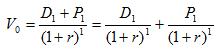
Assume an investor wants to buy a stock, hold it for one year, and then sell it. To determine the value of the stock using DDM, the investor must estimate the dividend to be received during the period (D1), the expected sale price at the end of the holding period (P1), and the required rate of return (r). Then:
Multiple-Year Holding Period
If the investor anticipates holding the stock for several years and then selling it, the valuation estimate is harder. You must forecast several future dividend payments and estimate the sale price of the stock several years in the future.

Free Cash Flow to Equity (FCFE) Model
Free cash flow always reflects the capital that can potentially be paid out to shareholders, notwithstanding the dividend policy.
Inputs:
- Cash flow: cash flow available to common shareholders after debt service
- Discount rate: cost of equity
- Best for: non-dividend-paying firms with predictable FCFE.
This model is preferable to DDM models when actual dividends differ significantly from FCFE. The cash flow used is the cash flow from operations net of capital expenditures and debt payments (including both interest and repayment of principal).
Free Cash Flow to the Firm (FCFF) Model
Inputs:
- Cash flow: cash flow to all capital providers.
- Discount rate: WACC
- Best for: levered firms
The cash flow is cash available to shareholders and bondholders after taxes, capital investment, and WC investment. Discounting free cash flow to the firm at WACC gives the value of the whole firm. Subtract the market value of debt to reach equity value, then divide by shares outstanding.
Residual Income Model
Inputs:
- Cash flow: net income minus equity charge
- Discount rate: cost of equity
- Best for: firms with negative cash flow, no dividend, and reliable book equity and earnings
Residual income for a given period is the earnings for that period excess of the investors' required rate of return on beginning-of-period investment (common stockholders' equity). That is, it equals accounting earnings minus opportunity costs of invested capital.
or
RIt = NIt - re x Bt - 1
where
NIt is the net income during period t.
re is the required rate of return on equity.
Bt - 1 is the beginning-of-period book value of equity.
Residual income attempts to match profits to the time period in which they are earned but not necessarily realized as cash. The approach adds the present value of residual income to the original debt and equity investments in the company. It takes the perspective of equity investors so residual income is discounted at the cost of equity.
User Contributed Comments 0
You need to log in first to add your comment.

I just wanted to share the good news that I passed CFA Level I!!! Thank you for your help - I think the online question bank helped cut the clutter and made a positive difference.

Edward Liu
My Own Flashcard
No flashcard found. Add a private flashcard for the subject.
Add