- CFA Exams
- 2027 Level I
- Topic 5. Equities
- Learning Module 1. Equity Instrument Features
- Subject 2. Private versus Public Equity Securities
Why should I choose AnalystNotes?
AnalystNotes specializes in helping candidates pass. Period.
Subject 2. Private versus Public Equity Securities PDF Download
Publicly listed and private equity securities contrast in their features across four dimensions: liquidity, disclosure, valuation, and access.
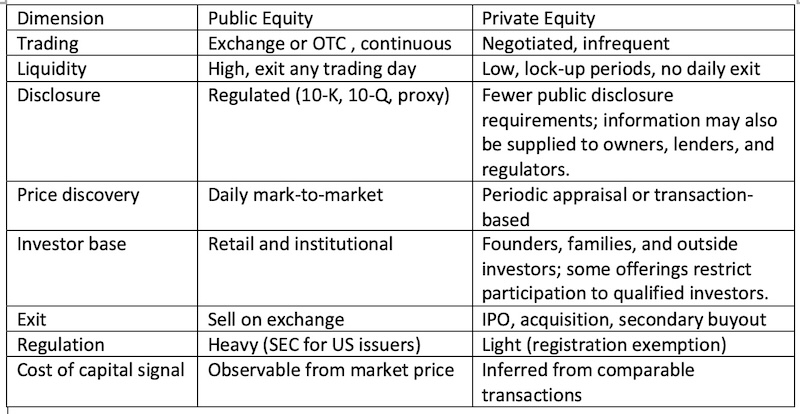
The defining differences are liquidity and disclosure. Public markets give continuous prices and standardized reporting. Private markets give neither, but offer concentrated influence and longer horizons.
Private equity is not a single product. Three categories matter:
Venture capital: is financing for privately held companies, typically in the form of equity in less mature companies, for the launch, early development, or expansion of a business. A venture firm must provide returns to its investors and has a long horizon to do so. Therefore, it has to make a high multiple on its investment and must hold out for a nice acquisition or an IPO. It must build the business from scratch to be able to carry a very high enterprise value.
Growth equity: invests in mature private firms scaling rapidly, typically minority stakes.
Leveraged buyouts: the acquisition of a company or division of a company with a substantial portion of borrowed funds. A buyout fund seeks companies that are undervalued with high predictable cash flow and operating inefficiencies. If it can improve the business, it can sell the company or its parts, or it can pay itself a nice dividend or pay down some company debt to deleverage.
Holders face an illiquidity premium, expected return above public equity to compensate for the inability to exit freely. Periodic valuations may lag market changes, masking short-run volatility without eliminating economic risk.
Depositary Receipts
A separate vehicle bridges cross-border equity. American Depositary Receipts (ADRs) and Global Depositary Receipts (GDRs) are negotiable certificates representing shares in a foreign company, held in custody by a depositary bank. ADRs trade in US markets in dollars, letting US investors hold foreign equities without dealing in foreign currency directly. GDRs are issued outside the issuer's home country and the United States and are usually US-dollar denominated.
User Contributed Comments 5
| User | Comment |
|---|---|
| bidisha | Pipe deal: warren buffet & Goldman |
| bidisha | Oops bank of america |
| ldfrench | bidisha: Is "warren buffet" a good place to eat? Let me know plz |
| farhan92 | a KFC buffet... |
| avinuela | Pipe deal: see Succession episodes 2 and 3 :) |

I was very pleased with your notes and question bank. I especially like the mock exams because it helped to pull everything together.

Martin Rockenfeldt
My Own Flashcard
No flashcard found. Add a private flashcard for the subject.
Add